GemNav: Discrete-Token Visual Robot Navigation using a Multimodal Large Language Model

CSIRO Robotics, Brisbane, Australia

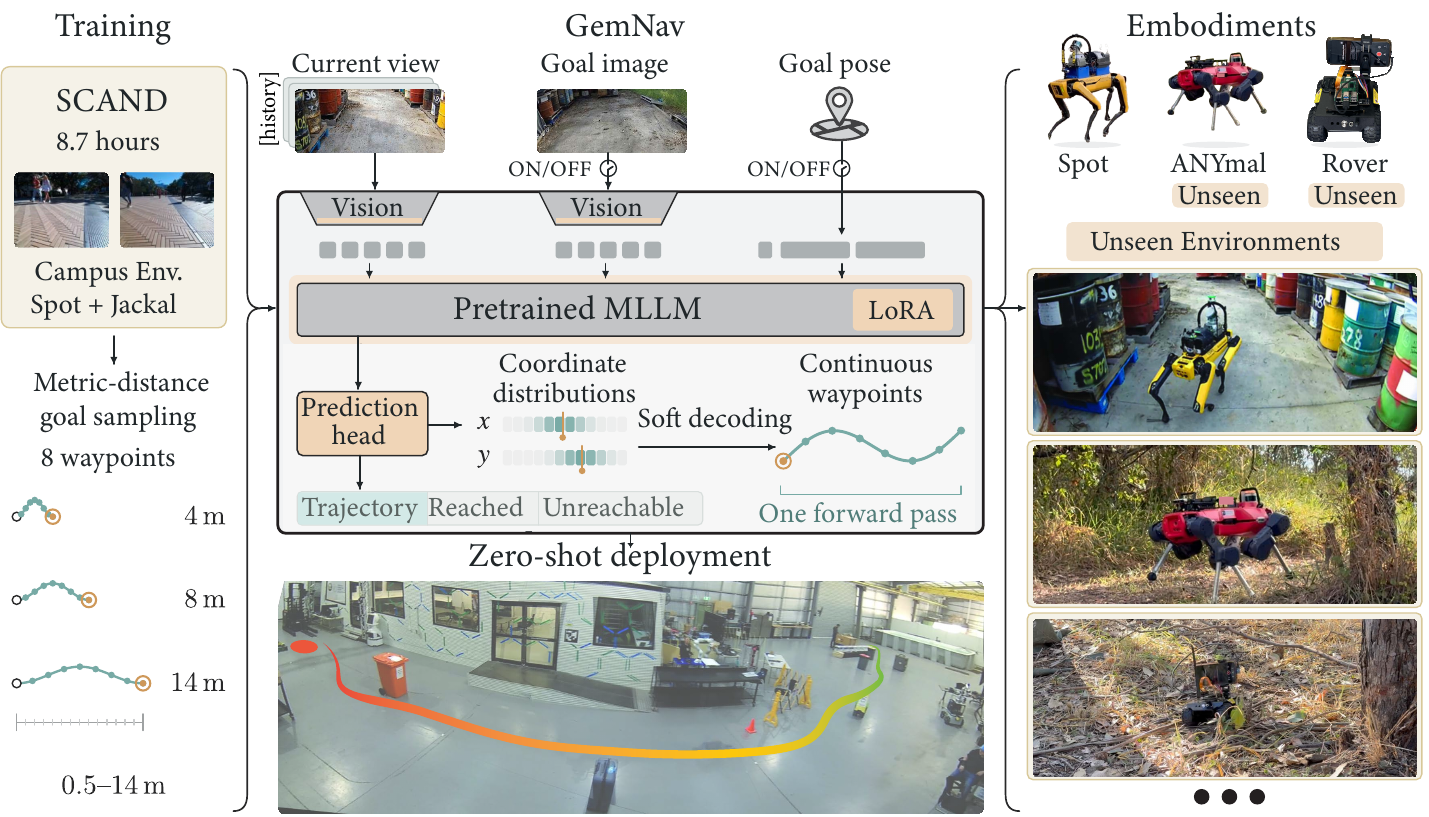
GemNav turns a pretrained multimodal LLM into a visual navigation policy. Trained on just 8.7 hours of data, the same checkpoint navigates zero-shot on Spot, ANYmal and WAVE ROVER.

Abstract

Visual navigation policies built on large pretrained models increasingly rely on large cross-embodiment datasets and expressive action-generation mechanisms. In this paper, we ask whether a pretrained Multimodal Large Language Model (MLLM) can be adapted efficiently for robot navigation by rethinking the representation and construction of navigation actions.

We introduce GemNav, a visual navigation policy that represents each robot-local waypoint coordinate as a categorical distribution over discrete metric value bins and soft-decodes it into a continuous coordinate for execution. This probabilistic representation retains likelihood information over alternative coordinate values while providing a compact action space suitable for robot navigation. We further construct training trajectories using metric-distance goal sampling rather than fixed future frame offsets, exposing the policy to varying physical navigation horizons independent of dataset frame rate and robot speed.

GemNav is trained on a single 8.7-hour public SCAND dataset, roughly three orders of magnitude smaller than competing cross-embodiment datasets. Extensive offline and closed-loop experiments show improved out-of-distribution generalization over frame-based sampling and substantially more reliable obstacle navigation than a matched continuous regression head. The same policy transfers without per-platform retraining across unseen environments and three physically distinct robot platforms.

Video

Method

GemNav overview: metric-distance goal sampling on SCAND, a LoRA-adapted MLLM with a prediction head producing coordinate distributions and a navigation state, and zero-shot deployment on Spot, ANYmal and WAVE ROVER.
Overview. Left: metric-distance goal sampling produces eight-waypoint targets over varying physical horizons. Center: LoRA adapts the vision and language towers for image, 2D pose, or image+pose goals; a prediction head outputs categorical coordinate distributions for eight waypoints and a navigation state in one forward pass. Right: the same checkpoint transfers to Spot, ANYmal and WAVE ROVER.

Discrete metric bins

Each waypoint coordinate is a categorical distribution over 64 uniform bins spanning ±15 m. Soft decoding (the expectation over bin centers) gives a continuous coordinate, while the distribution keeps track of alternative paths, such as passing an obstacle on either side.

Metric-distance goal sampling

Training goals are sampled by physical distance (0.5–14 m) rather than a fixed number of future frames, so the policy sees varied navigation horizons regardless of dataset frame rate or robot speed.

Efficient MLLM adaptation

A frozen Gemma 4 backbone is adapted with LoRA on both vision and language towers. One forward pass predicts eight waypoints plus a navigation state (trajectory, goal reached, goal unreachable), so the robot knows when to stop.
Zero-Shot Real-Robot Results

Every experiment below uses the same SCAND-trained checkpoint, with no per-platform retraining. ANYmal and WAVE ROVER are unseen embodiments.

8.7 h

training data (SCAND only)

3

robot platforms

10/10

image-goal trials reached

0.49 m

final error, Chemical Yard (OmniVLA: 16.54 m)

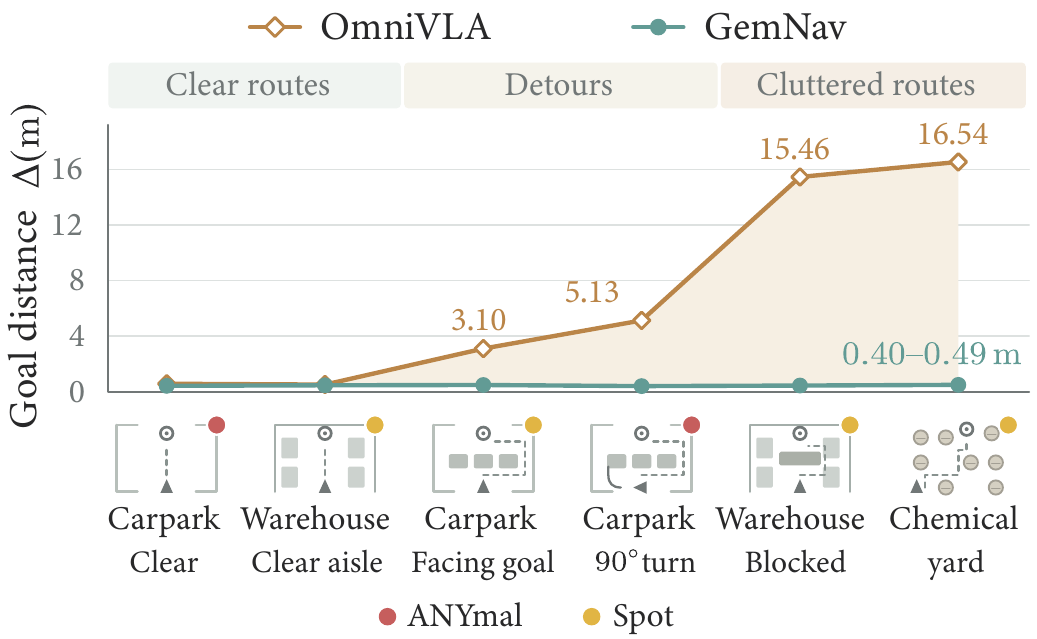
Goal distance error across courses: OmniVLA rises from under 1 m on clear routes to 16.54 m in the Chemical Yard, while GemNav stays between 0.40 and 0.49 m.
Final distance to goal as courses get harder. GemNav stays within 0.40–0.49 m, while OmniVLA's error grows to over 15 m on cluttered routes.

Image-goal navigation

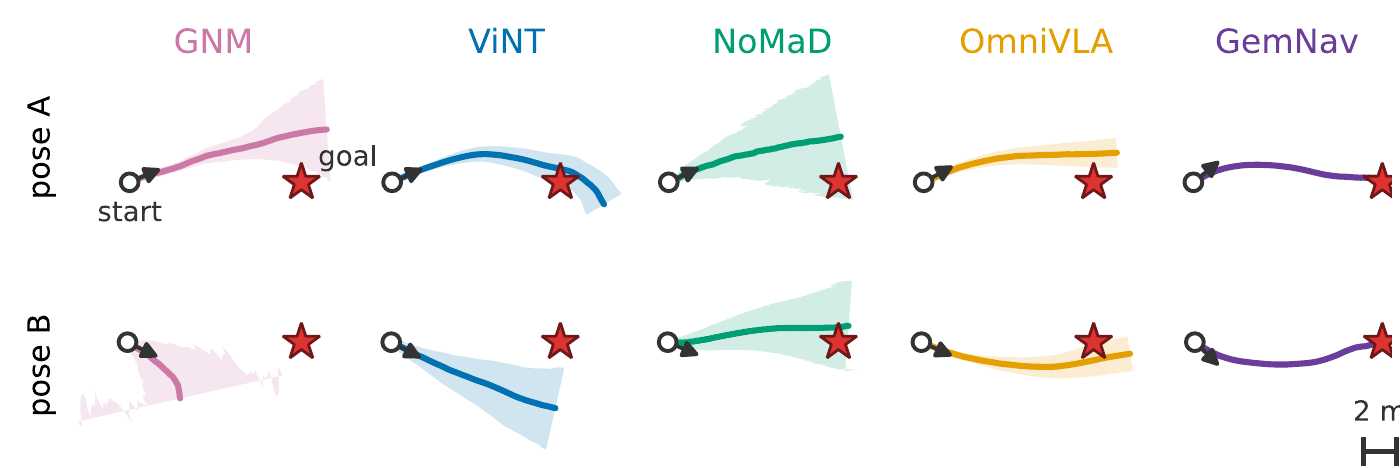
In the obstacle-free Open Approach on Spot, GemNav reaches and stops at the goal in all ten trials (0.31 ± 0.11 m final displacement), compared with OmniVLA's closest approach of 1.45 ± 0.38 m. GNM generally stays at least 3 m away, while ViNT and NoMaD succeed reliably from only one of the two initial headings. On the unseen WAVE ROVER, it reaches the image goal in all five trials (0.64 ± 0.12 m).

Image-goal trajectories of GNM, ViNT, NoMaD, OmniVLA and GemNav in the Open Approach on Spot.
Mean trajectories and variation over five trials per policy and initial heading (Spot).

Image-goal navigation on ANYmal, an unseen embodiment

Pose-conditioned navigation through obstacles

With 2D pose and image+2D pose goals, the gap grows when the robot has to leave the direct line to the goal. In the Warehouse, blocking an otherwise clear aisle barely changes GemNav's error (0.46 → 0.44 m), while OmniVLA's closest approach rises from 0.51 to 15.46 m. In the Chemical Yard, GemNav reaches and stops at the goal in all five trials.

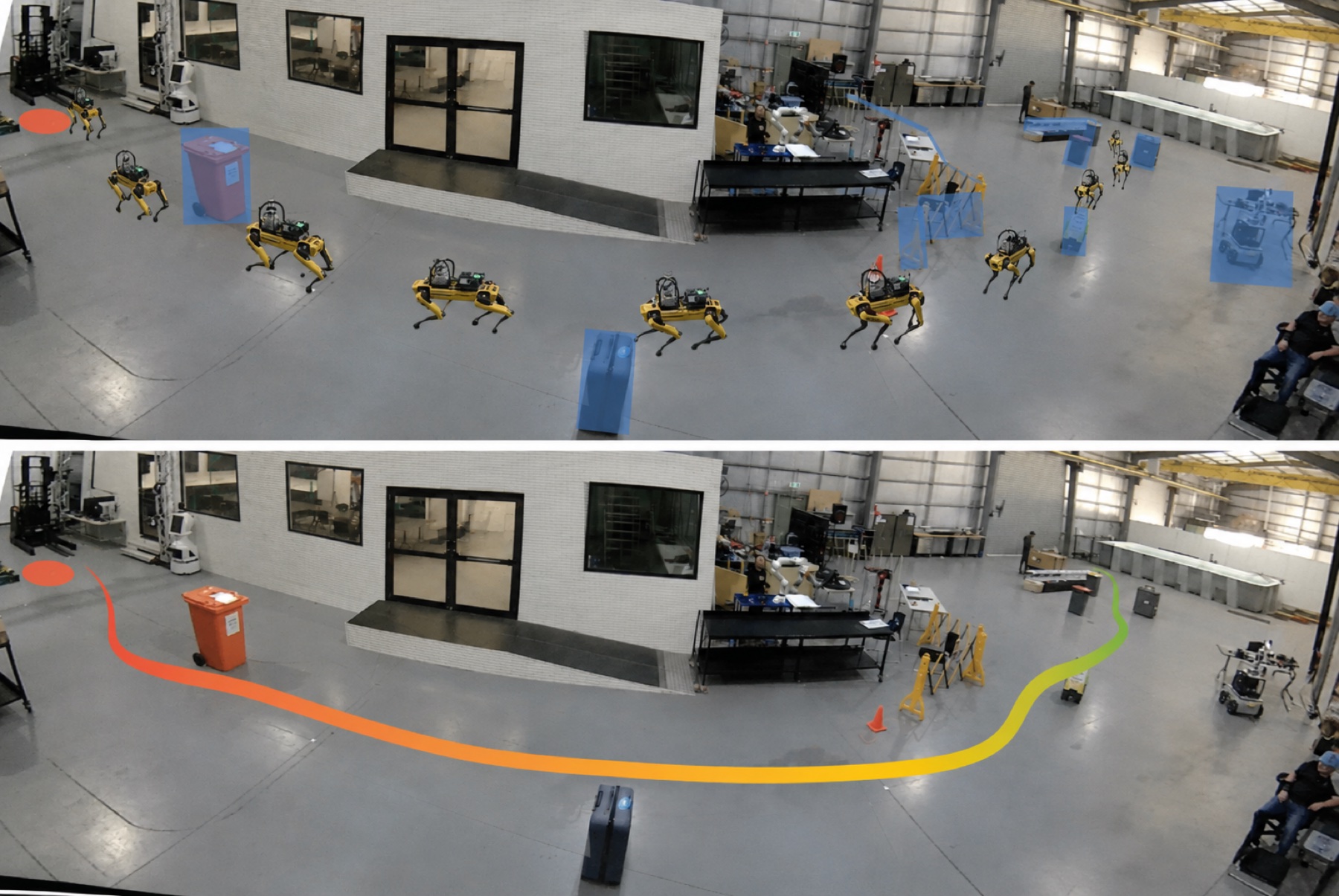
Warehouse composite: Spot weaves between obstacles from start to goal, with the path drawn as a colored line.
GemNav on Spot in the Warehouse course, threading through obstacles to the goal.
Image+2D pose navigation trajectories on Spot in the Warehouse (clear), Warehouse (blocked), and Chemical Yard.
Image+2D pose navigation on Spot, five trials per policy. (a) Warehouse (clear), (b) Warehouse (blocked), (c) Chemical Yard. Gray marks obstacles; squares and crosses mark goal stops and obstacle contacts.

Warehouse, clear then blocked aisle: GemNav (left) vs. OmniVLA (right)

Chemical Yard: GemNav (left) vs. OmniVLA (right)

Goal displacement Δ (m, mean ± std, lower is better), five trials per method and setting on Spot. Dashes mark settings not run.
DifficultySetting Image 2D Pose Image + 2D Pose
OmniVLAGemNavOmniVLAGemNavOmniVLAGemNav
EasyOpen Approach (A)1.77±0.070.41±0.050.32±0.070.43±0.040.22±0.090.42±0.06
Open Approach (B)1.13±0.280.20±0.050.48±0.060.39±0.020.91±0.220.42±0.04
MediumDetour Course (90°)––3.23±1.980.42±0.025.13±0.100.40±0.03
Warehouse (clear)––––0.51±0.070.46±0.03
HardWarehouse (blocked)––––15.46±0.120.44±0.03
Chemical Yard––15.89±0.300.44±0.0316.54±0.020.49±0.02

Off-road navigation in natural terrain

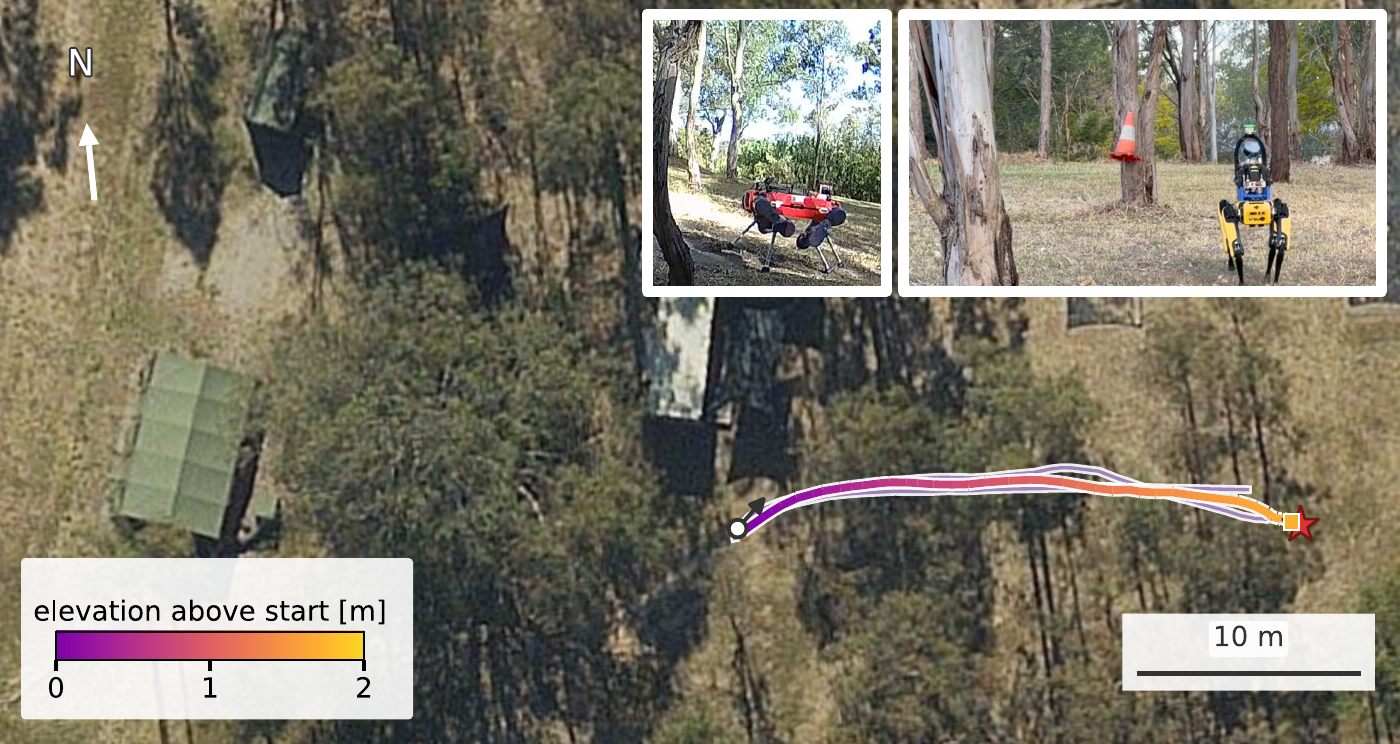
Deployed on irregular bushland with dense vegetation and trees, ANYmal reaches the goal in all seven uninterrupted trials (0.44 ± 0.07 m) and Spot in both uninterrupted trials (≈0.43 m). With a 2D pose goal, the unseen WAVE ROVER stops at the goal in two of three trials (0.33 and 0.51 m), and passes within 0.88 m of it in the third.

Off-road trajectories of ANYmal and Spot on natural terrain with goals and stops marked.
Zero-shot off-road navigation with image+2D pose goals. Stars mark goals; squares mark stops.

Spot, ANYmal and WAVE ROVER on natural terrain

Why Discrete Tokens?

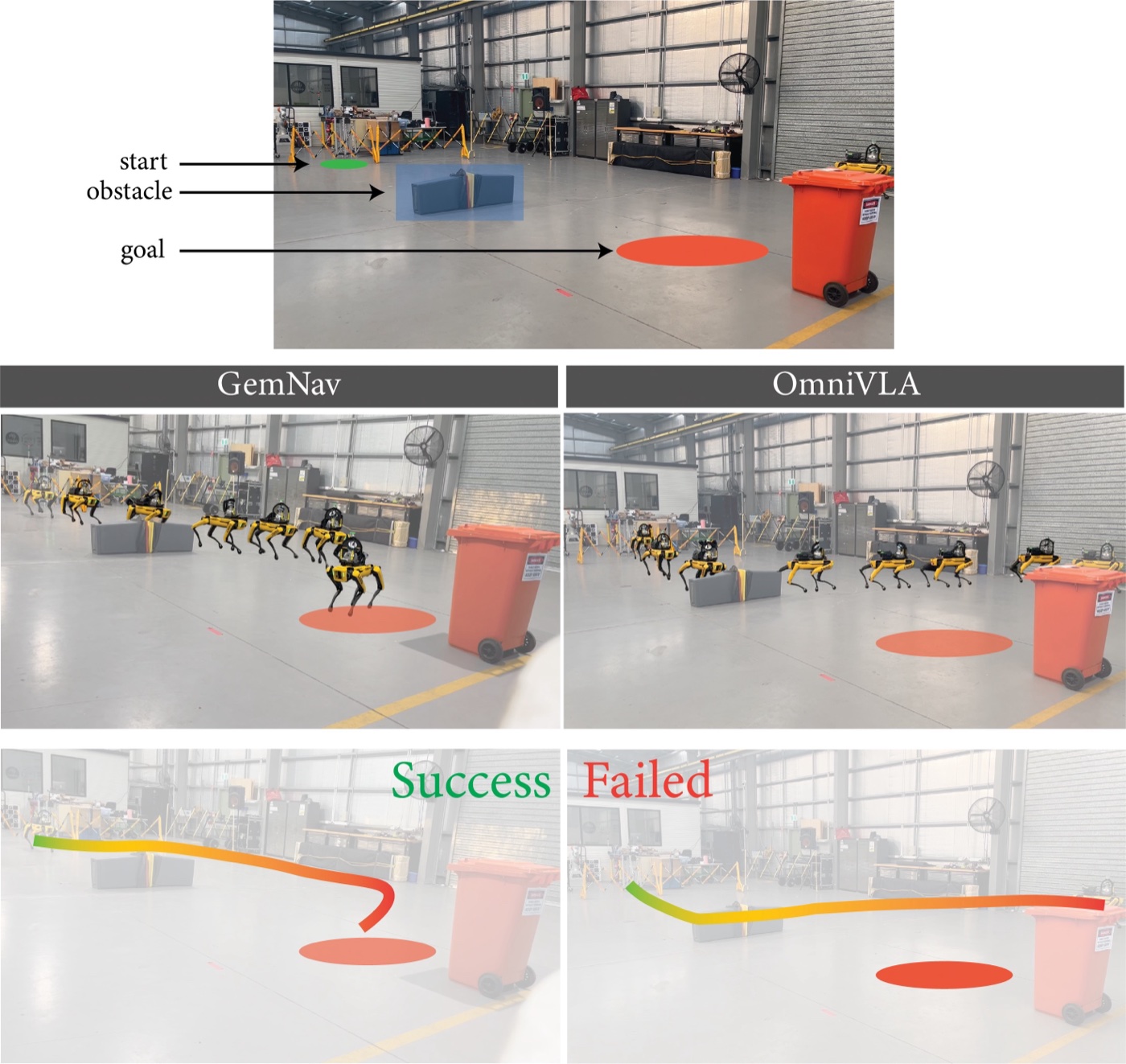
When there are several feasible paths, such as passing an obstacle on the left or the right, a continuous regression head tends to average them into a straight line through the obstacle. We compare against a matched L1 regression head with the same backbone, LoRA configuration, data, and training. On the Detour Course, GemNav passes the obstacle line and stops at the goal in 10/10 trials (0.48 ± 0.07 m). The L1 head drives into the obstacle in all 10 trials, and OmniVLA (continuous head, L2 loss) behaves similarly, with a closest approach of 3.10 ± 0.09 m.

Detour Course trajectories: GemNav reaches the goal 10/10 by passing the obstacle on either side; the L1 head (0/10) and OmniVLA (0/5) drive straight at it.
Detour Course with an image+2D pose goal. GemNav passes the obstacle line on either side (10/10); the L1 head (0/10) and OmniVLA (0/5) drive straight at it.
Single-obstacle course on Spot: GemNav detours around the obstacle and stops at the goal; OmniVLA drives past the goal into the bin.
Single-obstacle course on Spot: GemNav detours and stops at the goal; OmniVLA misses it.

Detour Course, onboard view

Offline Evaluation

We compare eight predicted waypoints against recorded trajectories on held-out SCAND and on two unseen datasets, TokenWalker and WildCross[1] (off-road). GemNav has the lowest ADE/FDE across all datasets and goal modalities.

GemNav predictions on a WildCross forest sequence, with the goal 8 m ahead. The policy was never trained on off-road data.

Offline eight-waypoint prediction error, ADE / FDE in meters (lower is better).
ModelImage2D PoseImage + 2D Pose
SCAND (in-distribution)
GNM2.83 / 5.48––
ViNT2.89 / 5.56––
NoMaD2.58 / 4.61––
OmniVLA2.55 / 4.632.56 / 4.702.53 / 4.64
GemNav0.76 / 1.200.37 / 0.180.33 / 0.19
TokenWalker
GNM2.68 / 5.22––
ViNT2.71 / 5.21––
NoMaD2.40 / 4.31––
OmniVLA2.63 / 4.772.76 / 4.932.54 / 4.60
GemNav2.09 / 3.640.78 / 0.190.75 / 0.19
WildCross (off-road)
GNM2.80 / 5.35––
ViNT2.78 / 5.29––
NoMaD2.41 / 4.32––
OmniVLA2.95 / 5.362.76 / 4.982.67 / 4.81
GemNav1.81 / 3.170.50 / 0.180.39 / 0.18

[1] J. Knights, J. Reid, K. Roy, D. Hall, M. Cox, P. Moghadam. WildCross: A Cross-Modal Large Scale Benchmark for Place Recognition and Metric Depth Estimation in Natural Environments. IEEE ICRA, 2026.

BibTeX

@article{bohm2026gemnav,
  author  = {B{\"o}hm, Peter and Rahman, Saimunur and Khamis, Abdelwahed and Shrestha, Sagun Man Singh and McCool, Chris and Moghadam, Peyman},
  title   = {{GemNav}: Discrete-Token Visual Robot Navigation using a Multimodal Large Language Model},
  journal = {arXiv preprint arXiv:2607.06882},
  year    = {2026},
}